Thursday, June 9, 2016

Wedding Vows - Reflections on Shavuot 5776

Bea & Sam Gisser, August 1985
On their fiftieth wedding anniversary, our Bubbe and Zayde renewed their wedding vows under a stunning gold lame chuppah, and then, in their inimitable style, threw a party to end all parties. Every family member and friend they could think of was invited. People dressed to the nines (fahrpitzed in Yiddish), the five-star food rocked, Ruby Melnick's orchestra wailed, and the wine flowed. And people talked about that party for years.

Zayde always said: make the effort to attend the simchahs (celebrations), because on the sad occasions you have to go.

What ingredients go into a successful marriage, one that makes it to the 50 year milestone and beyond? 

First are the open and effusive expressions of love between the partners; second are the daily acts, little and large, that demonstrate that love, nurture it and keep it alive; and third is the inherent good character and trustworthiness of the partners themselves. 

With those three ingredients, any marriage will go the distance. Two out of three and the marriage will endure for a while; but with only one out of the three, the prospects for long-term success are not brilliant.

This weekend, Jews have a simchah to attend. Sunday (and Monday in the Diaspora) are Shavuot, the annual holiday when we renew our wedding vows with the A-lmighty. For Shavuot is the anniversary of receiving the Torah - our ketubah (marriage contract) - at Mount Sinai, a mere 3,328 years ago. (My! How the time flies.)

Like Bubbe's and Zayde's marriage, the marriage between the Jewish People and Gcd rests on the same three pillars: our expressions of faith in the One True Gcd; our performance of His mitzvot that demonstrate that love, nurture it and keep it alive; and finally, our inherent good character as embodied in our Jewish lineage, as descendants of the Patriarchs and Matriarchs of old.

Pop quiz: which of those three components is the most important: Jewish pedigree, keeping the mitzvot, or belief in Gcd?

Most people would probably answer Jewish pedigree, because almost everyone knows Jews who are non-observant. Also, most people are familiar with the Halachah (Jewish law) that if a Jewish woman "marries out", i.e., to a non-Jew, her children will still be considered Jewish in the eyes of Jewish Law.

And yet they would be very wrong. [Your surprised face here.]

That rule was a concession to the fact that in olden days, it was not uncommon for young Jewish women to be taken captive by foreigners, conquerors and rapists. (In fact, in Israel today it is estimated that over 3,000 Jewish women have been seduced or kidnapped and are held against their will by abusive Moslem husbands in Arab villages, which, thanks to the Oslo Accords, are out of the reach of Israeli authorities.) The Sages of Israel, understanding the holy nature of Jewish women, assumed that such women would inculcate Jewish values and a sense of Jewish identity in their children, even in situations of extreme abuse and duress. 

And those who understand this Halachah as giving license to marry out are probably not aware that after four successive generations of intermarriage, the children are no longer considered Jewish. (Sad to say, we bear witness in our times that it doesn't usually take that long.)

The correct answer, at least according to the Rambam and other prominent authorities, is belief in the One True Gcd. Why? Because from our clear understanding of the Ikarei HaDat, the Fundamentals of the Jewish Faith, everything else follows. People who understand the Unity and Indivisibility of Gcd; who understand that Gcd actively runs the Universe and and takes a personal interest in the minutest details of every human life; people who acknowledge the authority of Torah - Gcd's Law - in their life; such people will perform the mitzvot enthusiastically, and convey that enthusiasm to their children, continuing the 4,000 year chain of pedigree which we can trace back to the Patriarchs and Matriarchs.

And what of converts, you may ask? After all, they lack that chain of pedigree. If, as I argue, to be Jewish is to possess not just one or two, but fully all three of these ingredients, how can converts ever be truly Jewish?

This not a question, because sincere converts have a better pedigree than natural-born Jews. 

People who grew up working on the Sabbath, and who grew up eating cheeseburgers, who grew up with the norms of a secular or idolatrous society; such people, who abandon everything they recognize as normal and familiar, to attach themselves to the destiny of the Jewish People and follow the path of Judaism, most especially including the specifics of Jewish Law, are considered to be the direct, first generation descendants of the Patriarchs Abraham and Sarah themselves:
Take yourselves from everything that is familiar to you - your land, your culture, your father's house, to the unknown land that I will show you. (Genesis 12:1)
And thus will the generations that follow the righteous convert merit to have all three components.
Where you go I will go, and where you live I will live. Your people will be my people and your God my God. (Ruth 1:16)
To be a Jew is to embody all three components, for a three stranded rope does not easily break (Ecclesiastes 4:12). Until the Enlightenment, such a statement would hardly have merited comment. However today, broad swaths of Jews no longer recognize the authority of Torah Law in their lives, and the liberal streams of Judaism give religious sanction to agnosticism in the name of intellectual integrity.

Because we are no longer a community bound together by a set of common axioms and postulates, all that remains to unite the Jewish world is our common ancestry. We are no longer a faith community, rather we are most tenuously connected one to another by our lowest common denominator. And that, in my humble opinion, is a tremendous poverty. Because when one's Jewish identity is based upon ethnicity alone, it speaks more to who your grandparents were than to who your grandchildren will be. 

And this sad state of affairs is the precipitating cause of the modern crises of who is defined as a Jew and whose conversions are to be considered valid.

Somehow, we must once again become a community united by a common faith and a shared belief system. 

So my challenge to you this Shavuot is to renew your wedding vows with the A-lmighty. Take a few minutes to reflect on the basics of your relationship with Gcd. 

Here's your homework:

1.) Curl up in a comfy chair.
2.) Pour yourself a glass of wine or a mug of soothing jasmine tea.
3.) Read through and reflect upon each one of Rambam's Thirteen Principles of Faith, which can be found in any reputable prayer book. 
4.) After the holiday, hit me up with your questions.

May Gcd bless the Jewish People with Unity rooted in Belief, Unity rooted in Torah, and lastly, with the bonds of Brotherhood and Family.

Chag Sameach.

(To read an earlier post on the holiday of Shavuot, please click HERE.)

Thursday, May 26, 2016

The Economics of Human Dignity - Reflections on Parashat Behar 5776

(Leviticus 25:1 - 26:2)

If you want to construct a utopian economic order, put down Das Kapital and pick up Parashat Behar.

Parashat Behar deals in large measure with the laws of Shemitah, the sabbatical year. Here's the basic 411: for six years, landowners work their fields, plant their seeds, reap their harvests, pay their taxes. But in the seventh year, everyone's land lies fallow; ownerless, as it were. The rich and poor alike are free to glean from whatever perennial fruits, vegetables and grains that grow wild. Hoarding is strictly forbidden. Fences come down, and domesticated livestock and even wild animals are free to trample in the fields and eat their share unmolested.

Because in the seventh year, the land reverts to its true owner, the A-lmighty Gcd who created the heavens and the earth.

Furthermore, all personal debts are forgiven in the seventh year, and indentured servants are released.

After seven shemitah cycles, that is, 49 years, the fiftieth year is the Jubilee year. Three amazing things happened in the Jubilee year: (1) Jewish servants who (for whatever reason) refused to leave their masters earlier, were forcibly emancipated; (2) the Jubilee year was an additional sabbatical year in which everyone's fields lied fallow for a second consecutive year, and (3) all real estate transactions became null and void, with the land reverting to the original seller, the owner of the ancestral plot.

The grand, overarching theme of these rules is the preservation of human dignity. While rewarding innovation and hard work, the Torah describes an economic system that establishes human dignity as its core value, far above the profit principle.

How so?  Every area of human economic endeavor ultimately derives from the earth. From the food we eat, to the steel, glass and rubber that we use to build our automobiles, to the silicon that makes the chips for our devices, to the trees and concrete we use to build our homes, to the energy we utilize to make it all run - all of it comes from the earth. 

By observing the sabbatical year on the Land, we acknowledge that whatever measure of financial success we enjoy is dependent upon the earth, which in turn is wholly due to Gcd's beneficence. Shemitah shatters the myth of the self-made man who answers to no one but himself (and of course worships his creator); of the notion that there is no limit on the accumulation of wealth; of the notion that we are free to spend the fruits of our labors according to our fickle whims and peccadilloes.

Rather, Shemitah drives home the idea that we are mere stewards of everything that we possess, and that we have an attendant responsibility to manage those gifts wisely.

Once we recognize our indebtedness to Gcd for our own successes, we are prepared to advance to the next step and recognize that our fellow is co-equal to us as a servant of Gcd, also created in His Image and equally important and valuable in His eyes. His right to be treated fairly in the deal is no less important than our own. 
Whether you are a seller or a buyer, don't take advantage of your fellow in the deal. (25:14)
That fact will guide the conduct of our financial transactions with others, and the sum of those human-dignity-based transactions create the Torah's utopian economy.

Rule: Indentured servants should go free after no more than six years - laden with gifts, and ready, eager and retrained in their new trade to make a respectable living as freemen. 

Rule: No servant of Gcd can have two masters forever, and must be freed in the Jubilee.

Rule: If a person is reduced to working for an hourly wage, treat him as an artisan at his job and do not humiliate him through demeaning work.

Rule: If a person should sell their ancestral plot out of dire necessity, the obligation falls to his immediate relatives to redeem his land for him that he may once again live with dignity. If he or his family cannot raise the funds to bail him out any sooner, it perforce reverts to him in the Jubilee year.

Rule: Personal loans are forgiven in the Shemitah year to allow the destitute a chance for a fresh start, for hope and for dignity.

Rule: The reversion of land to its ancestral owners in the Jubilee year prevents the concentration of disproportionate amounts of wealth in the hands of the very few.  It was an economic "reset," the original anti-trust legislation.

Here in the United States, we are suffering through a season of political astonishment: liberals are astonished that a brash demagogue like Donald Trump could be the presumptive Republican presidential nominee, while conservatives are astonished that Bernie Sanders, an unapologetic socialist, can garner 40% of the Democratic vote.

But the United States is also a place where the gap between the rich and the poor continues to widen; where the dream of home ownership as the primary path to personal wealth is evaporating; where taxes, already punitive and confiscatory, continue to rise, in order to feed an intrusive and metastasizing government and service an out-of-control sovereign debt; where labor is treated as disposable, to be spent, exploited and discarded when no longer of use. 

Both Trump's and Sanders' approaches are deeply, deeply flawed. Unfettered, rapacious, slash-and-burn capitalism is fundamentally unethical. And socialism has failed in every setting it has been attempted, because it punishes, rather than rewards, the natural human impulse to build, create and innovate. 

Parashat Behar shows us the middle path: a benign capitalism that puts people before profit. It provides capitalist financial incentives for innovation, criminalizes exploitation of labor, and provides mechanisms for the economic protections for all citizens of the Jewish society.

Because the underpinning of a dignified, meaningful Torah life is the ability to make a respectable living. 

Maybe this parasha should have been called The Heart of the Deal.

Shabbat Shalom.


Thursday, May 12, 2016

Karate Kid Kedushah - Reflections on Parashat Kedoshim 5776

(Leviticus 19:1-20:27)

Someday, in the very distant future, when I approach the podium to - reluctantly - accept the Nobel Prize for Thought-Provoking Torah Blogs Presented Through the Medium of Trombone, I will have many people to thank: my wife, my kids, my parents, the Academy...

This week, though, I must give a nod to three great people: Rashi, Rav Kook and Pat Morita.

First the Rashi: This week's Torah portion begins with the general exhortation to be holy, and then continues with a list of 51 specific mitzvot/commandments, understood to be the means for achieving a holy life. 

In verses 19:11,12 we read:
Don't steal, and don't deny the truth, and don't tell lies to one another. And don't swear to a lie by My Name, that you should desecrate the Name of Gcd, I am Gcd.
Pretty solid advice. However Rashi sees these commandments, not as separate injunctions, but as being connected to one another: "If you steal, you will deny it, leading you to tell an outright lie to cover it, ultimately leading you to take a false oath in Gcd's Name." 

Rashi's brilliant insight got me to thinking about the idea of connectedness in all the mitzvot in Parashat Kedoshim.

If you go back and study the structure of the narrative, you will detect an interesting pattern: the mitzvot (or cluster of interrelated mitzvot) are presented in couplets, punctuated by the statement Ani Hashem/I am Gcd.

A man should fear his mother and father
And My Sabbaths you should observe
I am Gcd.

Do not turn to false deities
And do not make for yourselves physical representations of Gcd
I am Gcd.

[The laws of the peace offering]
[Set-asides for the indigent and the dispossessed]
I am Gcd. 

(I could go on, but if you check it out for yourself, you'll see that the structure holds.)

In each case, beyond the simple meaning of each mitzvah, the structure of the coupled mitzvot teach a meta-lesson. 

Take the first couplet: the underlying rationale for respecting one's parents is the same for observing the Shabbat and holidays. The respect accorded to our parents - as those who created us, gave us life and nourished us - is the same respect we accord to Gcd as our Creator, Who has given us life and has nourished us. And observing the Shabbat bears eloquent witness that Gcd created the entire universe, including us.

Or the last example: don't think that you can get right with Gcd by bringing a peace offering with great fanfare in public, while stealing from the poor in private. (Bam! You now understand the Book of Isaiah.)

All well and good. But why couplets? Why not triplets or quatrains?

The Torah is teaching us something very profound about what it means to be holy. The parasha opens with "Kedoshim Ti'hiyu," you should be holy because I, The Lcrd Your Gcd, am Holy. The couplets speak both to a perfected world that will be, and to the imperfect world that we currently inhabit. 

One the one hand, the parasha outlines a perfected, messianic society; a model in which the poor are provided for, where there is no cheating or stealing or lying or narcissism. A society in which we love one another as we love ourselves, without deceit and subterfuge. A world united in the common recognition that every good thing emanates from the Source of All Goodness. Perhaps that is why the exhortation of Kedoshim Ti'hiyu is phrased in the future tense, not in the present tense.

One of my favorite scenes in the original Karate Kid (1984) is when, early in the movie, Mr. Miyagi (Pat Morita) teaches Daniel-san how to trim a bonsai:


I view the bonsai as a metaphor for the work of tikkun olam/perfecting the world to the Gcdly ideal.

As Kedoshim, holy ones, our task is to focus single-mindedly on that idealized society, without distraction, seeing nothing but the bonsai; taking the world that is handed to us and transforming it into the picture of that perfected, messianic society that the Torah describes and which we envision in our mind's eye. For the seventy generations since the destruction of the Holy Temple in Jerusalem we have been hard at it, and with each passing generation, through the performance of these mitzvot, we draw ever closer to that ideal. 

But how do Kedoshim deal with the imperfections of the world along the way? What of the evil-doers, idolaters and oppressors of the poor? That is the other part of the couplet, of dealing with the world the way it is.


In this, we are guided by luminaries such as Rav Avraham Yitzhak HaCohen Kook. Although we of course never met (he passed over to the World of Truth in 1935), his teachings resonate in my soul so deeply that I, like many others, consider myself to be an intellectual heir, a disciple of his.

In his day, Rav Kook had many detractors, particularly in the Old Yishuv of Jerusalem. They set about publishing and distributing many scurrilous pamphlets and posters, shamelessly excoriating him personally and lampooning his magnum opus, Orot.

And yet, as an exemplar of holy behavior, he never took the bait. He never struck back, replied, or even attempted to defend himself against the scathing criticism of his accusers. He held his tongue and absorbed the abuse without complaint; to the contrary, he dealt with his accusers kindly, never withholding alms even for those of the other camp who knocked on his door in desperate need. 

That is the mark of a holy person. The true litmus test of Kedoshim is how they deal with the darkness they encounter along the way. To aspire to holiness is to never lose sight of the big picture. The bad guys may have the momentary upper hand, but they never prevail. This, too, is the lesson of the couplets in our parashah.

Every Othello has his Iago. As many readers of this blog are already aware, my family and I have been harassed by an irksome madman who has spread monstrous rumors about us to anyone gullible enough to listen. It's also no secret that his whispering campaign has cost me several rabbinic positions. 

In his boundless arrogance, he considers himself Gcd's gift to the Jewish people, but he is much less like the messiah, and much more like Daniel Greer; and Benny Minster and Toviah Singer and his other felonious cronies.

Guided by the example of Rav Kook, we have done our best to ignore him and his wild lies, and we will not dignify his sordid accusations with a public response.

To the contrary: the talmud in Tracate Kiddushin 32 states that a true talmid chacham/student of Torah overlooks insults to his reputation and doesn't chase honor. So people are free to say whatever they want about us, it is of no concern. The A-lmighty above knows the whole truth, and that truth has a funny way of revealing itself in the end.

There is a very moving meditation that is said right before going to sleep for the night: 
Master of the Universe, I hereby forgive anyone who angered or antagonized me or has sinned against me either personally, or financially, or against my reputation; whether he did so accidentally, intentionally, carelessly or purposely; whether in speech, deed, thought or idea...may no person be punished on my account.
And of course there is the thrice daily meditation at the end of the amidah: "Give me the fortitude to let my soul be silent in the face of those who accuse me falsely."

I hope and pray that this "Iago" receives the spiritual and psychological counseling he so desperately needs. As for me, I entrust myself to those who know me best: first and foremost my precious family; and my rabbanim, my colleagues, my students and my true friends.

The key is not to be distracted by the maligners. We must not get caught up in the nonsense; rather, we must keep working towards creating the perfected society portrayed in Parashat Kedoshim. That was the path of Rav Kook.

For my part, I will continue to teach Torah undeterred, in order to bring Gcd's People closer to His service; and in so doing, hope to make a small contribution to the collective endeavor of our National Bonsai.

Shabbat Shalom.

Wednesday, April 20, 2016

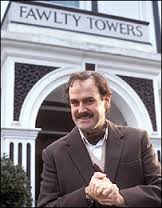
Fawlty Fear - Reflections on Pesach 5776

The Seder is the central ritual of the Passover holiday. It's origins are embedded in the Torah verse that says, "And you shall tell your child on that very day, saying: because of this which the A-lmighty did for me when I went out of Egypt." [Exodus 13:8]

The Hebrew word for 'And you shall tell' - V'Higad'ta - is the same Hebrew word root as Haggadah - the booklet that guides us through the Seder, because the Seder revolves around the retelling the history of the Exodus from Egypt.

And that's what we do - we tell our kids the story of the Exodus - hopefully engaging them with fun and excitement and smiles. The Seder itself is replete with unusual ritual practices, the eating of exotic foods, and the singing of curious songs, all designed to goad the kids into asking "why?"

One of those curiosities occurs towards the end of the Seder. Picture this: everyone's had a wonderful meal - incredible food, good wine, and witty banter. Appetites are sated, the family and friends are relaxed and in a really good place (if perhaps only a little tired). Then, right after we drink the third goblet of wine, we get stone serious for a minute. We get up from the table, open the front door and proclaim the following verses:
Pour out Your wrath on the nations that refuse to recognize You and upon those kingdoms who do not call out Your Name. For they have devoured Jacob and destroyed his high places. Pour Your scorn out upon them, and let Your fiery anger overtake them. Chase them in Your anger and destroy them from under Gcd's heavens.
What a change of mood! And what - exactly - are we shouting into the street? 

Passover night is called Leil Shimurim, the night of watchfulness, for it was on this night that the A-lmighty struck the final horrific blow to our enemies in Egypt. For once - on this one night - we had nothing to fear from our persecutors, no more fear of backlash or retribution.

So every year on this night, we relive that Freedom From Fear that our ancestors experienced, and proclaim to the public square that Jew haters really have no bone to pick with us Jews; their true enemy is the Jewish Gcd, and Gcd will fight His own battles. On this one night, we are basically saying to Hamas, and ISIS, and the PLO, and Iran, and CNN, and MSNBC, and NPR, and the BBC, and the British Royals, and the Vatican, and the UN, and the BDS, and all the other Jew haters out there: come at me, bring it on, because tonight you can't touch this; tonight I am protected.

Tonight I have nothing to fear.

And now for something completely different:

Brilliantly written and acted, Fawlty Towers was arguably one of the funniest sitcoms in the history of television. And in his recent autobiography, So, Anyway..., John Cleese notes that Basil Fawlty's painfully ridiculous antics were ultimately motivated by fear. Fear of being embarrassed in front of guests. Fear of his wife. Fear of the hotel failing the health inspection. Fear of guests discovering there was no cook in the kitchen. Whatever the cause, fear propelled him into wackier and wackier behavior, crazier and more outlandish lies. Foolish behavior, all intended to prevent him from looking...well, foolish.

What is so relateable about Basil Fawlty is that kernel of fear in us all, and how, in the end, he always manages to diffuse that fear and turn it into funny.

In my daily discourse with people from all walks of life, I pick up on a lot of fear floating around out there. After the boilerplate 'Hi how are you?'s and the dismissive responses of 'BH, I'm great, everything's chill', one cannot escape the sense that just under the surface, dark fear lurks. 

Some are worried for their jobs, or the ability to make rent, or the rising price of food. Some are worried about their health or the health of loved ones. Some are worried about the skyrocketing cost of higher education. Some are worried about politics or ISIS or al-Qaeda or Jihadist terrorism. [And yes, some people are actually worried about the baggage retrieval system at Heathrow.]

In the Jewish world, it seems that everyone's running scared. On the left, they are scared to confront the reality that all the well-intentioned innovations introduced over the last few decades have destroyed their congregations. On the right, we are mortified of social reproach if one doesn't embrace every faddish new chumra (stringency) under the sun. To quote my friend and mentor Rabbi Mordechai Escovitz, Rabbi Emeritus of the Touro Synagogue: for many, Yirat Shamayim is nothing more than Yirat Shcheino.

Like Basil Fawlty, our fears sometimes drive us to do painful and ridiculous things.

Passover teaches us to be less fearful, and instead to be more courageous and bold in following our own unique path in Torah and mitzvot. It takes guts to yell into the street: come at me, bring it on, because tonight I have nothing to fear.

We don't live in the ghetto anymore, and never again will we walk like sheep into the gas chambers. Miraculously, after a two thousand year hiatus, we have Jewish sovereignty in our ancestral homeland, a Jewish Army to defend it, and sooner or later, we are all going to wind up there, to return home.

So stop living afraid. Stop acting out of fear. Act out of courage and conviction. As the ultimate redemption unfolds before our eyes, Passover, the Holiday of Redemption, reminds us that everything will work out just fine. 

Now, on to that fourth glass of wine.

Chag Same'ach: a very happy, healthy and chametz-free Passover!

Wednesday, March 30, 2016

The Evolution of Food - Reflections on Parashat Shemini 5776

(Leviticus 9:1 - 11:47)

I cook for a living, and perhaps because of that, I think a lot about food. I suppose that makes me a "foodie." 

So, as this week's Torah portion deals with many of the rules of keeping kosher, that is, of eating in a kosher way, it could be that I've given the subject more than a passing thought.

Down through the ages, the Sages of Israel have used different approaches for understanding the significance of keeping kosher, but the broad consensus of rabbinic opinion is that keeping kosher confers spiritual benefits only, and does not contribute to our physical well-being.

In other words, kosher eating is not necessarily synonymous with healthy eating. 

I would like to challenge that assertion. But before I do, we need to discuss one or two salient details of Darwin's Theory of Natural Selection.

OK, I know you're thinking: aside from possibly eating a Galapagos finch (and fuggedabowdit they're not kosher) what could Natural Selection possibly have to do with keeping kosher?

Let's first make sure we're clear on Natural Selection. Here's a brief mythical example: imagine an idyllic South Pacific island, with a native tribe whom we'll call the Cute Residents of the Idyllic South Pacific Island, or CRISPIs for short. 

In the beginning of our story, all the members of the CRISPI tribe share similar genetics, and are of comparable height, skin color, eye color, etc. However, over the span of many generations, hundreds or even thousands of years, certain genetic variations begin to creep in. Maybe outsiders from far-flung atolls have paddled over, taken up residence, and started families with CRISPI maidens. Maybe the genetic variations are due to naturally occurring genetic mutations (CRISPIs spend a lot of time idylling in the sun).

Whatever the reason, over time, the CRISPI tribe starts looking more diverse than it used to. Some CRISPIs are now significantly taller and leaner than others, some have different color hair or eyes. (How that changing genetic information is physically expressed is called phenotype.)

And so everything plods along idyllically - until disaster strikes. A cargo container drifts ashore, and when opened, turns out to contain a den of (by now) very hungry zoo lions. 

In the face of this sudden environmental stress, different phenotypes now confer distinct survival advantages or disadvantages over others. For example, maybe faster, leaner CRISPIs have a higher likelihood of outrunning the lions and shimmying up a tree to safety than the slower, fatter CRISPIs. They're also more likely to be able to safely scoot down, grab some food and shimmy back up to safety. Since more of them are likely to survive in this difficult new environment, they are more likely to have more offspring, who in turn are fast and lean, and better suited to making it in the new reality. And before too many generations have elapsed, the slower, fatter CRISPIs will likely die out for the converse reason.

To summarize: before the cargo container opened, the genetic diversity among the population didn't mean very much; lean or chunky, tall or short, everyone strummed ukeleles and danced on the beach all day. But when the circumstances suddenly changed, that phenotypic diversity became the difference between life and death. Nature essentially selected out the fast, skinny CRISPIs to survive, and condemned slow, fat CRISPIs to extinction.

That is the concept of Natural Selection in a nutshell (did you notice how I snuck in another food reference right there?)

Now we can get back to the business of food and kosher.

America has become a nation of fat CRISPIs. A century ago, tuberculosis, typhoid and dysentery were the leading killers in America. Today, the top killers are diseases of affluence: heart disease, diabetes, stroke, cancer.

According to the National Institutes of Health:
  • More than two-thirds (68.8%) of adults are considered to be overweight or obese.
  • More than one-third (35.7%) of adults are considered to be obese.
  • More than 1 in 20 (6.3%) have extreme obesity.
  • Almost 3 in 4 men (74%) are considered to be overweight or obese.
  • The overall prevalence of obesity is similar for both men and women (about 36%).
  • About 8% of women are considered to have extreme obesity.
  • About one-third of children and adolescents ages 6 to 19 are considered to be overweight or obese.
  • More than 1 in 6 children and adolescents ages 6 to 19 are considered to be obese.  
Being fat is the new normal; there is no longer any shame in it.

I am also told by medical professionals that the overall cancer rate 75 years ago was about 1 in 15; today it is approaching 1 in 2.

What has changed in that time?

It's the food. THE FOOD. Our food has changed.

In the past, people sat down to meals prepared from raw ingredients; fresh meats from the butcher, fresh produce from the green grocer, fresh bread from the neighborhood bakery. Milk was delivered fresh every day from the local dairy. Another mythical person, the stay-at-home-mom, cooked these meals from scratch.

Somewhere along the line, that changed. Mommies went to work, and no one had time to cook. Supermarkets gradually drove the butchers and bakers out of business. Fast food franchises proliferated. Food ceased being food, and became a 'product,' and food production became an industry.

Once food becomes a product, like an iPhone or a Chevrolet, product consistency becomes a core business value. Food preservation and color retention and spoilage reduction factors become paramount. Today, supermarket shelves are chock full of 'product': preserved, pasteurized, homogenized, hydrolyzed, stabilized, texturized, re-formed, artificially colored and flavored, all designed to protect and service the food supply chain, which takes weeks to get the food "product" from factory floor to supermarket floor. And the FDA smiles benevolently on this cacophony of plastic food because studies (paid for by the food manufacturers) prove beyond a reasonable doubt that the preservatives don't kill laboratory mice (at least not right away, anyway).

And let's not even discuss the billions of advertising dollars spent to convince consumers that buying all this product is normal and cool and desirable, and oh! how you're missing out if you don't have Crunchberries for breakfast or a Coke with lunch.

Today, America is a country of soda guzzling, Big Mac chomping, Hot Pocketing, bacon loving, Hamburger Helpin', perambulatory heart attacks on a stick. The days of eating a home cooked meal that didn't derive from a box are in the rear view mirror.

Is it any wonder that we're obese, that we're cancer-ridden, that we have artificial knees and hips? That one in seven Americans are gluten sensitive, who can no longer tolerate the adulteration of wheat, which benefits the mega-bread factories? That food allergies that we never knew in our childhoods are exploding in frequency? 

We are committing suicide by plastic spork.

So it may well be that, up until recent times, keeping kosher only offered spiritual benefits. Maybe in the past, before this sea change in food, it was true that people who kept kosher were no more or less physically healthy than non-Jews who did not keep kosher. 

But the food environment has suddenly changed, and the difference between keeping kosher and not, differences that once didn't mean much in terms of physical health, may now mean the difference between life and death.

What does the Hebrew word "kosher" mean, anyway? It means 'fit', as in fit to eat. The food we eat should be fit for human consumption. And at its core, keeping kosher is all about paying attention, and being sensitive to, what we consume as food.

Kashrut itself has evolved. Veal and foie gras, once technically kosher, are now considered by many poskim (decisors of Jewish Law) to be not kosher, because we have become sensitized to the pain inflicted on the animal prior to slaughter.

And the mean time from factory to store is significantly shorter with kosher meat.

And because we Jews are careful to scrub our fresh produce for any evidence of bugs, we are also doing a pretty bang-up job of washing pesticides off our produce.

And of course, eating at McDonald's and Burger King and Taco Bell is (thank Gcd!) out of the question.

In the same way that our particular rules about frequent hand washing saved the Jews from the Black Death (so much so, that our non-Jewish neighbors accused us of causing it) our higher standard of what is fit to eat may well be inadvertently saving us from supermarket poison.

To be sure, it is possible, as the Ramban will remind us in a few weeks, to be a menuval b'reshut HaTorah, to fulfill the technical requirements of keeping kosher and still be a glutton, overweight and sickly. But I contend that the kiyyum, the fulfillment of the higher intent and spirit of kashrut, goes way beyond the slavish search for the kosher symbol on a package.

To really keep kosher is to think hard about the food we eat. As we approach the Passover season, I am amazed at how people lose their minds - and drain their wallets - buying exorbitantly priced Kosher for Passover cake and doughnut mixes and exotic candies and potato chips and ketchup and sodas and cookies and tortes - as if they won't survive for a week without them.

Here's a clever idea: this Passover, go native. Stick to lean kosher meats and fish, fresh fruits and vegetables, and a little matzah. Cook from scratch. Make a soup. Use fresh herbs. For that one week, avoid factory food and see how you do. 

We are the Or LaGoyim, A Light Unto the Nations; walking, talking examples of the myriad blessings of a Torah-centric life. That living example extends to every aspect of our lives, including the food on our tables and our physical health that derives from it.

Reflect on and really examine the food you eat. Really think about kosher. And you will find that keeping kosher confers both spiritual and physical benefits that only the Author of Life Himself could have foreseen when He gave us the great gift of Torah some 3,328 years ago.

Shabbat Shalom.

(To read an earlier blog post on this Torah Portion, click HERE.)

Sunday, March 20, 2016

Confronting Evil - Reflections on Parashat Zachor 5776

In the weeks before Passover, Jews the world over read four special Torah portions. (These readings are in addition to the regular weekly Torah reading cycle, in which we read the entire Five Books of Moses cover-to-cover over the course of the year.)

Yesterday, we read the second of the four, Parashat Zachor. The text is as follows:
Remember (Zachor) what the Amalekites did on your way out of Egypt; that they happened upon you on the way and attacked the stragglers and all the weak ones in the rear when you were the most tired and exhausted, and they did not fear Gcd. Thus it shall be that when the Lcrd your Gcd establishes and makes you secure from your enemies around, in the Land that He will give you as an inheritance to possess it, erase (timcheh) the memory of Amalek from under the heavens - never forget (lo tishkach). (Deuteronomy 25:17-19)
Amalek is archetypal evil. Amalek tells the world that there is no Gcd, no order in the universe, and therefore, no notion of good and bad. Amalek encourages war and chaos and destruction, because in that milieu he thrives - free to oppress the weak, to rape, pillage and plunder. Amalek is Haman. Amalek is Hitler. Amalek is Stalin. Amalek is every godless, Jew-hating despot who has trampled through the garden of human history.

Amalek viciously opposes both aspects of the Jewish national destiny - to be a Kingdom of Priests, i.e., to minister to Gcd on behalf of all the peoples of the earth, and to be a Holy Nation, distinct and set apart from the rest, focusing on our own spiritual development and maintaining our special relationship with Gcd.

Therefore, Amalek seeks to destroy the Jew, the conscience of the world. And it is against Amalek that the Jewish People must take a stand. That is the meaning and import of these verses.

But if we torque down on the verbiage used here, there seems to be an inherent contradiction. 

The opening and closing phrases of these verses are Zachor…Lo Tishkach - 'remember' and 'don't forget.' In opposition to that idea, we have the commandment to erase the memory of Amalek from under the heavens. 

Do you see the problem? If we successfully blot out Amalek from under the heavens, if we erase them and their memory from the history books (like Will and Ariel Durant tried to do to the Jews in their history of Western Civilization); if we really do that job properly, like reformatting a hard drive, there can be no trace of Amalek, and therefore nothing to remember. 

So which one is it: do we continually remind ourselves of their evil deeds, or do we reformat the hard drive of human history from any trace of Amalek?

And while we're asking hard questions, let’s pile on another: Immediately after the war with Amalek, Gcd tells Moses: 
Write this remembrance in a book, and speak it in the ears of Joshua: That I (Gcd) will utterly blot out the memory of Amalek from under the heavens. (Exodus 17:14)
So who is supposed to be doing the blotting out - we here on earth, or Gcd on high?

To answer these questions, let’s come back to our first text, Parashat Zachor: First, how do we understand the seeming redundancy of Zachor-Lo Tishkach/Remember-Don't Forget?

There are several approaches to this problem.

The Sifri suggests that zachor suggest a verbal declaration, while lo tishkach is a commandment to keep this reality alive in the heart at all times.

The Malbim says that zachor is positive commandment while lo tishkach is a negative commandment, two sides of the same coin. 

The Ibn Ezra points out that lo tishkach is linked to, and intended to strengthen the zachor, meaning: even if you are not yet established and secure in the Land of Israel, not yet able to be pro-active against evil, always keep your passion against evil burning brightly.

Based upon this Ibn Ezra, one possible answer to our question is that the verses describe a sequence of events: the remembrance/not forgetting aspect of the mitzvah apply only before Amalek is eliminated. Once Amalek is successfully blotted out, the commandment to remember Amalek falls away.

Here is another possible approach.

Let’s look at the Hebrew word to erase, limchot. What is curious is that there is an even stronger Hebrew verb, limchok, to utterly blot out. It would seem that limchok denotes complete erasure, the language of wiping the hard drive. But the Torah doesn't use the language of mochek, it uses the language of mocheh. So what does mocheh mean?

Mocheh means erasing, as in scribblings on a piece of paper. And as any school child can tell you, no matter how hard you erase, some faint impression of what was written remains. 

Mocheh also means diluting or dissolving. Further, we see the word mocheh in the Talmud denoting protesting or annulling. 

For example, on Baba Batra 38b, a landowner can be mocheh, protest, against the illegal occupation of his property in the presence of two witnesses. And on Ketubot 11a, minors who are converted by their parents have the ability to be mocheh (annul or to protest) their conversion.

This understanding, taken together with the verses in Shemot/Exodus cited earlier, suggests the following:

Amalek rears it's ugly head in every generation. Therefore, in every generation the Jews have a moral obligation, a mitzvah, a charge - limchot - to dilute their influence, to protest their murderous actions, to annul their power with any means at our disposal.

But that job won't be finished in a single generation. Therefore, we have the parallel charge of zachor - to remember the evil that is Amalek; to remember that this war against Amalek will span many generations. 

As Rabbi Tarfon says in Avot 2:16: It is not your responsibility to singlehandedly complete the work [of perfecting the world]; but your inability to complete the task does not free you from the responsibility of contributing to it.

Perhaps this is why, even in the first encounter with Amalek, the Torah records that Joshua and his warriors were only able to weaken Amalek, but not vanquish them completely. [Exodus 17:13] Amalek survived to fight another day.

How do we dilute the influence of Amalek in the world? Any high school chemistry student can tell you that to dilute any strong concentration, you add more solvent. And the way that Rav Kook taught us to fight evil was not necessarily to confront it head on (although sometimes that, too, is necessary), but rather to flood the world with good: do more mitzvot, both in quantity and quality; study more Torah; reach out to our wayward brethren. By flooding the world with good, we dilute the power of evil.

Over the long span of time, through advances and retreats, every successive generation annuls, weakens, dilutes the influence of Amalek bit by bit, until the time of Mashiach. Then, the Glory of Gcd will be manifest in the world, and all doubts will be resolved. In that post-historical world, Gcd Himself will utterly obliterate evil from under the heavens.

May we all merit to witness that happy day.

Happy Purim.

Monday, March 14, 2016

Off the Hook - Reflections on Parashat Pekudei 5776

(Exodus 38:21-40:38)

Pssst. Don't tell anyone you heard it from me, but I heard that Moshe is a thief. 

Believe it or not, Moshe Rabbeinu, the greatest prophet and leader in the history of the Jewish People, is accused of petty theft in this week's Torah portion. Can you even believe it?  Here’s what happened:

According to the medieval commentary Daat Zkainim miBaalei HaTosafot, the bean-counters discovered that, somewhere between what was donated for the construction of the Mishkan/Tabernacle and what was fabricated, there was some silver missing. The whispering campaign had begun. Maybe Moshe had pocketed a few shekels? Skimmed a few dollars off the top?

Moshe refers to the Mishkan as the Mishkan HaEdut, the Mishkan of Testimony, because the mishkan itself would testify to his innocence. He demands a recount of all the vessels in the Mishkan, and sure enough, 15 extra vavin/hooks were cast, which accounted for the discrepancy.

The Daat Zkainim goes on to say two fascinating things: First, the verse from last week that says V’Hamlachah Hayta Dayam, "...and the materials [donated] were sufficient for the work at hand." In gematria/numerology, the initials of those three words come to the number 15. Second, that having been exonerated from this terrible accusation, Moshe voiced 15 expressions of praise to Gcd, corresponding to the 15 extra hooks.  Thus the number 15 became associated with praise to Gcd. That is why, down to this day, we have 15 morning blessings, and we begin and end the section of the morning prayers dedicated to praising Gcd with 15 expressions of praise: 15 in the Baruch She’amar prayer, and 15 expressions of praise in the Yishtabach prayer. Neat. 

But let’s come back here for a minute. Imagine: lashon hara, baseless accusations against Moshe, threatened to mar the construction of the greatest spiritual shrine and engineering feat of ancient times. Forget the Hanging Gardens of Babylon or the Sphinx or the other wonders of the ancient world. The Mishkan eclipsed them all.

The building of Gcd’s sanctuary was thrown into tumult because of groundless accusations against an innocent person. Somehow, the malshinim, the whisperers, imagined that Moshe could be holy-looking on the outside, but corrupt on the inside…maybe just as corrupt as they were on the inside.  In psychology, this is called projection: that is, to deflect attention from yourself, you imagine your own faults in others. Nathaniel Hawthorne wrote a short story on this subject called Young Goodman Brown. Check it out sometime.

What is the antidote to lashon hara, slander? I think it can be found in the name of our Torah portion: Pekudei.

Following the commentaries, most translations render pekudei as “counting,” in Hebrew cheshbon, so that the opening phrases of our Torah portion read, "These is the accounting of the Mishkan, the Mishkan HaEdut, as was counted at the command of Moses..." Straightforward enough. 

But I think that that translation is inadequate. Why? Back in Chapter 21 of Genesis, the Torah says, V’Hashem pakad as Sarah c’asher amar…/And Gcd PKD-ed Sarah as He said he would..." Did Gcd count her there? Trust me, that lady was one of a kind, so that can't be. In this context, the Hebrew word root PKD seems to mean remember.

And what about later in Genesis 50:24, where Joseph says in his dying words to his brothers, Pakod ifkod etchem vha’aleita etchem…/And Gcd will certainly PKD you and bring you up out of this land [Egypt]..." - again same word root – but over here the sense of the word is that that Gcd will ultimately redeem the Jewish People from Egypt. But if PKD means to redeem, then isn’t the second half of the verse, "...and bring you up out of this land [Egypt]..." redundant?

Now of course it’s possible for one word to have multiple, disparate meanings. Count. Remember. Redeem. But I’d like to suggest a unified understanding of the word PKD that ties them all together.

Here’s the idea: the word root PKD means “that which Gcd focuses his attention upon.” So in our Torah portion, the first phrase, Ayleh HaPekudim/"These are the PKDs” refers to the fact that the A-lmighty was focused upon the materials used in the building of the Mishkan HaEdut in order to exonerate His faithful servant Moses against laughable accusations of wrongdoing.

By the birth of Isaac, Gcd focuses his attention upon Sarah in order that Avraham and Sarah could conceive the miracle baby Isaac in their dotage.

By Joseph, PKD means that Gcd will focus his attention on the Jewish People and their plight in Egypt, AND THEREFORE v'ha’aleta etchem, He will lift you up and return you to Eretz Yisrael.

Does that make sense?

Last week was Shabbat Shekalim, the first of the four special Torah readings in the run-up to Passover.  Guess what? the wording of PKD is also used in reference to the Machtzit HaShekel, the annual half shekel contribution donated by everyone over the age of twenty. (Exodus 30:12) Why? Because the half shekel was so much more than a census or a tax. As each individual passes by the pushka/coin box and drops in his half shekel contribution, he is, for that brief moment, the focus of Gcd's attention. Kivakorat Roeh Edro: This imagery is common on Rosh HaShanah, the Shepherd inspecting his flock one by one as each sheep passes through the narrow gate.

So if Gcd is focusing on us…then we had better get our squash together so that we might withstand His scrutiny.

How? The Talmud in Yoma 72b (which, by the by, is discussing the symbolism of the holy vessels of the Mishkan) quotes Rava as follows: a person should be like the Ark of the Covenant, covered inside and outside with gold, tocho k'baro. In other words, your inner being and private actions should be consistent with your outer self. If a person’s tocho is aino k'baro – that is, one’s public persona is religious, respectable, but their private thoughts and behavior are corrupt and reprehensible, such a person can never be a true servant of Gcd. Those are Rava’s words, not mine.

Elsewhere, (Brachot 28a) we learn that Rabban Gamliel refused entrance to his Academy to any student whose tocho was not k'baro.

The great malady of our times is that most of us lack the inner eye - we tend make snap judgments of our fellow solely on the basis of chitzoniut, externalities, and are blind to a person's pnimiut, their true nature. 

And so it is that scoundrels can dress like pious Jews and commit all kinds of monstrous sexual and financial crimes, whisper all manner of character assassination, project their own twisted sins upon others, and get away with it, all because they look religious. 

The behavior of these individuals is a Chillul Hashem, a repudiation of the very Gcd they purport to represent. 

But I take comfort in the fact that the truth always wins out in the end. "Rabbi Yochanan ben Broka said, 'Anyone who commits a chillul Hashem in private will come to have their crimes exposed in public." (Avot 4:5)

Tocho k'baro means being authentic. If we are truly focused on improving our own character traits, our own Torah learning, our own mitzvah performance, our own connectedness to Gcd, then we won't have time for lashon hara: not to speak it, or listen to it from others. And if it is spoken about you, you will be impervious, because, like Moses of old, you can be assured of Gcd’s help when the whisperers come gunning for you.

V'dai l'maivin.

Shabbat Shalom.

To read an earlier blog on this Torah portion, click HERE.