A very dear elderly woman cornered me one Shabbat morning at kiddush. "I was taught from an early age that women are forbidden from ever kissing the Torah Scroll because we may have our period and be unclean." She said it stoically, but the hurt of it lived in her eyes.
I confess that upon hearing this revelation, I almost choked on my pickled herring.
To those not steeped in the world of Talmud and Halachah, the concepts of "tumah" and "taharah" developed in this week's parashah are perhaps the most misunderstood in the entire Torah. A veil of superstition has enveloped these concepts, and it must be said that these misunderstandings have distanced many people from their Creator. It is a very, very deep and complex subject, and cannot possibly be adequately explained in a brief blog post.
Daunted as I am by the complexity of the topic, I would nevertheless like, in the words of H.L. Menken, to 'unscrew the inscrutable' and attempt to offer a little clarity to this confused topic. So buckle your belts, here we go.
First, nomenclature: the word tumah (noun) or tamei (adjective) is usually translated into English as spiritually unclean/impure/defiled. Conversely, taharah (noun) or tahor (adjective) is rendered as clean/pure/holy. Here we encounter the heart of the difficulty; these English words carry with them connotations which simply do not exist in the Hebrew, so let's just agree that there is no good way to translate them. As we shall soon see, I shall propose an alternative framework with which to define these terms.
We have to begin our analysis of tumah/taharah by thinking about the concept of mitzvah/fulfilling the commandments of the Torah, and chet/violating or blowing off the commandments listed in Torah. Carrying out the commandments is positive and meritorious, and is the very definition morality and goodness, while violating them is the exact opposite. These concepts are crystal clear: mitzvah - good; chet - bad.
Having said that, I can think of mitzvot that by definition put us in a state of tumah, for example burying the dead. I can also think of mitzvot that can only be performed in a state of taharah, like bringing a Temple sacrifice. In fact, let's get all Cartesian here, and think of mitzvah/chet on a vertical axis and tumah/taharah on a horizontal axis like so:
Since burying the dead is an act that is both a mitzvah and makes us tameh, that deed would be charted in the upper left quadrant. Bringing a Temple sacrifice would chart in the upper right hand quadrant. Murder would chart in the lower left. Get the idea? You could probably chart every mitzvah in the Torah in this way.
Now let's take this idea one step further, as in our case of burying the dead. Gcd Himself commands us to perform this good deed, therefore Gcd is commanding us to enter a state of tumah, as it were. So if doing Gcd's bidding puts us in a state of tumah, how can tumah mean something dirty or defiled or unholy or impure? It just can't be.
Unlike the vertical axis which represents good and evil, tumah and taharah refer to states of being. There is no perjoration attached to being tameh, nor is there any particular merit attached to being tahor. We make active choices to do good or evil, but in many cases, we are thrust into a state of tumah involuntarily. And unlike the good/evil axis, being tamei doesn't feel any different from being tahor.
Therefore, a more exact (if more clunky) rendering of tumah/taharah is a relative weakening/strengthening of our life force. OK...what the heck does that mean?
Just this: Gcd is the source of life, the eternal, constant vivifying force to all living beings. Thus Gcd is completely tahor. At the other extreme, the ultimate, mother-of-all-tumahs is a corpse. Death. The total absence of the vivifying life force and the polar opposite of both Gcd and everything godliness represents.
So where do humans fit into this scale? Somewhere in the middle. We cycle between states of tumah and states of taharah; that is the human condition. We are strong and then we weaken; we awake and then we must sleep. In fact, the Jew ritually washes his/her hands upon first arising to symbolize the "shaking off" of the tumah of nighttime, of the petit mort of surrendering our life force for a time while we sleep. But Gcd? The verse states: "Behold, the Guardian of Israel neither slumbers nor sleeps." Trying to avoid tumah is kind of like resolving to never sleep - it's just not possible for us lowly humans.
Why is a woman tamei after giving birth? Because the life that was within her is now external to her; she has experienced a relative diminution of her life force. And FYI: a man enters a mild state of tumah after a seminal emission, and for the same reason. It's not bad, it's not good; it just is.
Women are not Calcutta lepers during their period; Gcd forbid anyone should harbor such a horrible misconception! Nor is there an ancient, backward "blood taboo" in Jewish law, as pseudo-intellectuals would have us think. A menstruant is merely a drop less alive than before she shed an ovum, the potential of a new life. Again, it's not bad, it's not good; it just is.
It is natural to desire life and eschew death, both physically and spiritually, as reflected in our innate yearning to connect with Gcd, our wanting to be tahor. But we are not angels, we are humans, and confronting our own mortality from time to time is part of the human experience. That is the objective reality of the state of tumah. And if you think about it, tumah is actually a gift - a time of refraction and introspection. Later, when the time is right, the Torah provides a means of restoration to taharah, allowing the cycles of our lives to begin anew.
The Torah Scroll is impervious to tumah, and both men and women share the common need to connect with Great Wellspring of Life. And so to my dear kiddush friend I say: Kiss Away.
Shabbat Shalom.
"Ben Bag Bag said: Turn the Torah over and over because everything is in it." - Avot 5:26
Thursday, March 27, 2014
Friday, February 28, 2014
Sticktoitiveness - Reflections on Parashat Pekudei 5774
A striking characteristic of this week's parasha is the repeated phrase "As the Children of Israel were commanded by Gcd through Moses, so they did."
Now, OK, I get it: the parshiot of Trumah, Tetzaveh and half of Ki Tissa were the instructions, the engineering blueprints, if you will, for the construction of the Mishkan, the portable desert tabernacle. And Vayakhel & Pekudei describe the actual execution of the plans and the construction of the Mishkan. Yet it seems that with every cut of the saw, every bang of the hammer, every stitch of the embroiderer, the Torah reminds us that (you guessed it) "as the Children of Israel were commanded by Gcd through Moses, so they did." What are we supposed to learn from all the repetition?
The Kli Yakar and other commentators teach that this phrase is employed to punctuate the completion of each component of the Mishkan. Its appearance again after the Mishkan is completed suggests that the whole was greater than the sum of its parts.
Here's another idea: there is a quote that is variously attributed to either Mahatma Gandhi or that ancient and prolific poet, Anonymous (Don'tcha love that guy):
Thoughts become actions,
Actions become habits,
Habits become character,
Character becomes destiny.
True dat! No matter who wrote it, this is a very Jewish idea. Tiny actions, consistently performed, become habit; our habits come to define our character; and over time, our character, what we call in Hebrew 'Middot', ultimately determines our destiny.
In other words, Destiny doesn't care what college you attended, or how sweet your ride is, or your good looks, or your wealth, or the designer label on your jeans. Your destiny - what you ultimately accomplish in your life - is determined by your inner character traits: honesty, integrity, industry, frugality, humility, alacrity, equanimity, deliberate speech, etc.
Unfortunately, the incident of the Golden Calf graphically demonstrated how the opposite is also true: an errant thought led to a tragic deed, compromising our character and almost dooming our national destiny.
Since, in the view of most commentators, the Mishkan was the corrective for the Golden Calf, this repetition of "ken asu" (thus they did) underscores the contrition, the willing hearts and hands, of the Jewish People in the aftermath of the Golden Calf debacle. The Jewish People were sincerely penitent (the thought); what the parashah is showing us is the next step: consistent, steady action solidifying into firm habit. This consistency, over time, repairs our national character and thus our destiny as an Am Segulah, a Nation Set Apart.
The Mishkan is also intimately connected to the Sabbath. So perhaps we shouldn't be surprised to find a hint of this idea in the Lecha Dodi, the ultimate Sabbath hymn, sung on Friday evening, as we "rush out to the fields" to greet the Sabbath Queen. The stanza says that even though the Sabbath was the last of Gcd's creations, it was foremost in the Divine Consciousness: "sof ma'aseh, b'machshavah tchilah" (last in deed, first in thought.) But this stanza can also be understood to mean "thought precedes action."
To embrace our personal and national destiny, we must begin by changing ourselves. One resolution, leading to one seemingly trivial deed, performed consistently over time, can come to change the world. Do mitzvot, good deeds, even if you don't feel like it. Make them a habit, and their meaning will become clearer in the doing. Pretty soon, you won't be able to wait to do that mitzvah again. This is the meaning of the gemara which states that a mitzvah done for the wrong reason will ultimately come to be performed for the right reason. (Pesachim 50b).
May the day soon dawn when we as a Nation, as a Community of the Faithful, be able to declare in unison "ken asu."
Shabbat Shalom.
Now, OK, I get it: the parshiot of Trumah, Tetzaveh and half of Ki Tissa were the instructions, the engineering blueprints, if you will, for the construction of the Mishkan, the portable desert tabernacle. And Vayakhel & Pekudei describe the actual execution of the plans and the construction of the Mishkan. Yet it seems that with every cut of the saw, every bang of the hammer, every stitch of the embroiderer, the Torah reminds us that (you guessed it) "as the Children of Israel were commanded by Gcd through Moses, so they did." What are we supposed to learn from all the repetition?
The Kli Yakar and other commentators teach that this phrase is employed to punctuate the completion of each component of the Mishkan. Its appearance again after the Mishkan is completed suggests that the whole was greater than the sum of its parts.
Here's another idea: there is a quote that is variously attributed to either Mahatma Gandhi or that ancient and prolific poet, Anonymous (Don'tcha love that guy):
Thoughts become actions,
Actions become habits,
Habits become character,
Character becomes destiny.
True dat! No matter who wrote it, this is a very Jewish idea. Tiny actions, consistently performed, become habit; our habits come to define our character; and over time, our character, what we call in Hebrew 'Middot', ultimately determines our destiny.
In other words, Destiny doesn't care what college you attended, or how sweet your ride is, or your good looks, or your wealth, or the designer label on your jeans. Your destiny - what you ultimately accomplish in your life - is determined by your inner character traits: honesty, integrity, industry, frugality, humility, alacrity, equanimity, deliberate speech, etc.
Unfortunately, the incident of the Golden Calf graphically demonstrated how the opposite is also true: an errant thought led to a tragic deed, compromising our character and almost dooming our national destiny.
Since, in the view of most commentators, the Mishkan was the corrective for the Golden Calf, this repetition of "ken asu" (thus they did) underscores the contrition, the willing hearts and hands, of the Jewish People in the aftermath of the Golden Calf debacle. The Jewish People were sincerely penitent (the thought); what the parashah is showing us is the next step: consistent, steady action solidifying into firm habit. This consistency, over time, repairs our national character and thus our destiny as an Am Segulah, a Nation Set Apart.
The Mishkan is also intimately connected to the Sabbath. So perhaps we shouldn't be surprised to find a hint of this idea in the Lecha Dodi, the ultimate Sabbath hymn, sung on Friday evening, as we "rush out to the fields" to greet the Sabbath Queen. The stanza says that even though the Sabbath was the last of Gcd's creations, it was foremost in the Divine Consciousness: "sof ma'aseh, b'machshavah tchilah" (last in deed, first in thought.) But this stanza can also be understood to mean "thought precedes action."
To embrace our personal and national destiny, we must begin by changing ourselves. One resolution, leading to one seemingly trivial deed, performed consistently over time, can come to change the world. Do mitzvot, good deeds, even if you don't feel like it. Make them a habit, and their meaning will become clearer in the doing. Pretty soon, you won't be able to wait to do that mitzvah again. This is the meaning of the gemara which states that a mitzvah done for the wrong reason will ultimately come to be performed for the right reason. (Pesachim 50b).
May the day soon dawn when we as a Nation, as a Community of the Faithful, be able to declare in unison "ken asu."
Shabbat Shalom.
Friday, January 31, 2014
The Monopoly Metaphor - Reflections on Parashat Trumah 5774
So there I was, playing Monopoly with my kids. The turn passed to my youngest, who was down to her last few bucks (and no, I don't play cutthroat with little kids - don't even go there). She asked me, "Abba, what should I do? I'm almost out of money." I responded, "Give Tzedakah [charity]."
She thought about that for a minute. Her situation was truly dire. The tension around the board was TV game-show level. All eyes were upon her - what was she going to do? Finally, she took her last two dollars and pitched them on top of the bulging pot in the middle of the board. She rolled the dice, and lo and behold! - doubles, and the massive pot became hers. The crowd goes wild...true story.
I'm not dispensing financial advice here, but Number Four Daughter learned a very valuable lesson that day: the more you give, the more you get. In other words, the way to grow your stash is not to hoard it, but to give it away, and that is a seriously important life-lesson: to give tzedakah freely and with an open heart.
This week's parashah deals with the contributions collected by Moses for the construction of the Mishkan, the tabernacle in the wilderness. Among the items collected were gold, silver, copper and "red skins," pelts of a reddish goat.
The Midrash Tanchumah sees a deeper meaning in these items. It brings verses to suggest that these items foretell the rise of the four Great Empires. The gold is a hint to the rise of Babylon, the silver to Persia, the copper to Greece, and the red skins to Rome, (and by extension) to Western Civilization.
OK, very clever...but what does predicting the future have to do with building the Tabernacle in the wilderness? What is the sub-text of the midrash and how are we to understand it?
The Kli Yakar, the Chief Rabbi of Prague in the early 17th century, helps us out. He suggests that the gold that was given by the Jews in the wilderness was able to preempt - or at least mitigate - the destruction that Babylonia would later wreak. The silver was a palliative against Persia, the copper contributions against the chaos brought by Hellenism, and the red skins against the depredations of Rome. We didn't survive unscathed, but we nevertheless survived, and the Kli Yakar wants us to know that our very survival can be attributed in some measure to the tzedakah given so freely in the wilderness all those millenia ago.
There are a lot of good reasons to give tzedakah - first and foremost, it is a Biblical commandment to provide for the poor, so much so that if one doesn't give tzedakah, he or she is reckoned as an idol worshipper. (harsh!)
Secondly, by giving tzedakah we act as responsible stewards of Gcd's abundance that flows through our hands. That's why tzedakah is not charity in the way it is commonly understood; we are not parting with that which is ours, we are merely passing forward that which is Gcd's.
Thirdly, we are taught that it is a powerful atonement for our sins, our past failings.
But the insight that the Kli Yakar brings is truly remarkable: that the giving of tzedakah today can help mitigate future unforeseen disaster. Kind of like a spiritual "Get Out of Jail Free" card. And who couldn't use one of those?
So give tzedakah! Be pro-active, don't wait for some needy person to knock on your door. Better to give a penny every day with an open and loving heart than a million dollars with resentment. It is said that if we donated the amount of money we spend on coffee everyday in America we could cure a major disease.
Create opportunities to give. Find excuses to give. If you don't have one, buy (or better yet make) a tzedakah box for your house. It's a great project to do with your little ones. Get in the habit of throwing a coin in there every single day (except Shabbat, derp.)
Me? I had an uncle that would stand around for hours and just run his fingers through the change in his bulging polyester pants pockets. It sounded like there was four or five thousand dollars in nickels in there. Ever since, the old-man sound of jingling-jangling pocket change drives me nuts, so into the box it goes.
In the grand and unpredictable Game Of Monopoly, I may be the shoe and you the top hat, but my advice for winning is still the same: give tzedakah. You always get back way more than you give.
Shabbat Shalom.
She thought about that for a minute. Her situation was truly dire. The tension around the board was TV game-show level. All eyes were upon her - what was she going to do? Finally, she took her last two dollars and pitched them on top of the bulging pot in the middle of the board. She rolled the dice, and lo and behold! - doubles, and the massive pot became hers. The crowd goes wild...true story.
I'm not dispensing financial advice here, but Number Four Daughter learned a very valuable lesson that day: the more you give, the more you get. In other words, the way to grow your stash is not to hoard it, but to give it away, and that is a seriously important life-lesson: to give tzedakah freely and with an open heart.
This week's parashah deals with the contributions collected by Moses for the construction of the Mishkan, the tabernacle in the wilderness. Among the items collected were gold, silver, copper and "red skins," pelts of a reddish goat.
The Midrash Tanchumah sees a deeper meaning in these items. It brings verses to suggest that these items foretell the rise of the four Great Empires. The gold is a hint to the rise of Babylon, the silver to Persia, the copper to Greece, and the red skins to Rome, (and by extension) to Western Civilization.
OK, very clever...but what does predicting the future have to do with building the Tabernacle in the wilderness? What is the sub-text of the midrash and how are we to understand it?
The Kli Yakar, the Chief Rabbi of Prague in the early 17th century, helps us out. He suggests that the gold that was given by the Jews in the wilderness was able to preempt - or at least mitigate - the destruction that Babylonia would later wreak. The silver was a palliative against Persia, the copper contributions against the chaos brought by Hellenism, and the red skins against the depredations of Rome. We didn't survive unscathed, but we nevertheless survived, and the Kli Yakar wants us to know that our very survival can be attributed in some measure to the tzedakah given so freely in the wilderness all those millenia ago.
There are a lot of good reasons to give tzedakah - first and foremost, it is a Biblical commandment to provide for the poor, so much so that if one doesn't give tzedakah, he or she is reckoned as an idol worshipper. (harsh!)
Secondly, by giving tzedakah we act as responsible stewards of Gcd's abundance that flows through our hands. That's why tzedakah is not charity in the way it is commonly understood; we are not parting with that which is ours, we are merely passing forward that which is Gcd's.
Thirdly, we are taught that it is a powerful atonement for our sins, our past failings.
But the insight that the Kli Yakar brings is truly remarkable: that the giving of tzedakah today can help mitigate future unforeseen disaster. Kind of like a spiritual "Get Out of Jail Free" card. And who couldn't use one of those?
So give tzedakah! Be pro-active, don't wait for some needy person to knock on your door. Better to give a penny every day with an open and loving heart than a million dollars with resentment. It is said that if we donated the amount of money we spend on coffee everyday in America we could cure a major disease.
Create opportunities to give. Find excuses to give. If you don't have one, buy (or better yet make) a tzedakah box for your house. It's a great project to do with your little ones. Get in the habit of throwing a coin in there every single day (except Shabbat, derp.)
Me? I had an uncle that would stand around for hours and just run his fingers through the change in his bulging polyester pants pockets. It sounded like there was four or five thousand dollars in nickels in there. Ever since, the old-man sound of jingling-jangling pocket change drives me nuts, so into the box it goes.
In the grand and unpredictable Game Of Monopoly, I may be the shoe and you the top hat, but my advice for winning is still the same: give tzedakah. You always get back way more than you give.
Shabbat Shalom.
Wednesday, January 22, 2014
Stuff - Reflections on Parashat Mishpatim 5774
Remember George Carlin's shtick about "stuff"? That your house is really just a place to keep your stuff while you're out buying...more stuff?
Stuff. We all have stuff. Some of us have quite a lot of stuff. Carlin lampooned the mindless accumulation of stuff. And this week's parashah deals a lot with stuff (it also deals with a lot of stuff, but that's a different matter altogether.)
What struck me in re-reading Mishpatim this year is the careful language the Torah utilizes to describe a person's stuff.
Here's the case: Reuven is going on vacation and asks Shimon, as a favor, to keep any eye on his stuff. When Reuven returns, Shimon tell him, 'Bad news, bro. Your stuff was stolen.' Witnesses? None. Thief? Slipped away.
So the two obvious questions are (1) Did Shimon steal the stuff himself? and (2) even if Shimon is innocent of the theft, does he bear any responsibility for making good on the stolen stuff?
The second question is dealt with at length in the gemara, Tractates Bava Kama and Bava Metzia. As to the first question, listen to the language of the Torah: If the thief is not found, then the householder will approach unto Gcd [and take an oath in Gcd's name] that he did not extend his hand against the work [במלאכת] of his friend." Exodus 22:7
Why does the Torah use the curious term "melachah" to describe Reuven's 60 inch HDTV? Further, "melachah" means productive, creative work, as opposed to "avodah", routine chores or mundane labors. What are we to learn from this?
By way of context: Judaism teaches that we none of us truly own anything, even if we did pay for it. The A-lmighty is the "koneh hakol", the owner of everything, by virtue of having created the elements, molecules, and compounds which compose the flat screen TV, and the laws of physics which govern how it works. Gcd apportions His assets to whom He sees fit, when He sees fit; we are, at most, stewards of Gcd's stuff.
Stuff, in and of itself, is meaningless. If you've ever had the regrettable task of sorting through the stuff of someone who has passed away, you're struck by how trivial are the things that once meant so much; a favorite handkerchief or a pair of slippers or a chipped coffee mug. The detritus of a life stripped of its context.
But "melachah" - creative, productive, goal-oriented work - is meaningful. Melachah is associated with the creation of the universe; so it is that we abstain from melachah on the Sabbath. When we harness our creative energies to build and improve the world, we partner with the A-lmighty in the unfolding process of Creation.
And to be a builder, you need tools. You need your stuff. Painters need easels, canvases, brushes. Writers need quill and ink. Stuff only has purpose and meaning in the context of its contribution to the greater creative enterprise.
Every one of us is a builder and creator. The purpose of Jewish Civil Law, with which this parashah deals, is to create a level playing field where everyone is free to dream, to conceive and to build - their lives, their homes, their fortunes, their families. (The Hebrew words for sons and daughters - Banim & Banot - derives from the Hebrew root Boneh to build.)
Therein lies the answer. While the immediate matter at hand is Reuven's missing stuff, Shimon must swear that he has not extended his hand to jeopardize Reuven's melachah, his life's work. For only in the context of our life's work does the stuff have value, relevance and importance.
What are you building these days?
Shabbat Shalom.
Stuff. We all have stuff. Some of us have quite a lot of stuff. Carlin lampooned the mindless accumulation of stuff. And this week's parashah deals a lot with stuff (it also deals with a lot of stuff, but that's a different matter altogether.)
What struck me in re-reading Mishpatim this year is the careful language the Torah utilizes to describe a person's stuff.
Here's the case: Reuven is going on vacation and asks Shimon, as a favor, to keep any eye on his stuff. When Reuven returns, Shimon tell him, 'Bad news, bro. Your stuff was stolen.' Witnesses? None. Thief? Slipped away.
So the two obvious questions are (1) Did Shimon steal the stuff himself? and (2) even if Shimon is innocent of the theft, does he bear any responsibility for making good on the stolen stuff?
The second question is dealt with at length in the gemara, Tractates Bava Kama and Bava Metzia. As to the first question, listen to the language of the Torah: If the thief is not found, then the householder will approach unto Gcd [and take an oath in Gcd's name] that he did not extend his hand against the work [במלאכת] of his friend." Exodus 22:7
Why does the Torah use the curious term "melachah" to describe Reuven's 60 inch HDTV? Further, "melachah" means productive, creative work, as opposed to "avodah", routine chores or mundane labors. What are we to learn from this?
By way of context: Judaism teaches that we none of us truly own anything, even if we did pay for it. The A-lmighty is the "koneh hakol", the owner of everything, by virtue of having created the elements, molecules, and compounds which compose the flat screen TV, and the laws of physics which govern how it works. Gcd apportions His assets to whom He sees fit, when He sees fit; we are, at most, stewards of Gcd's stuff.
Stuff, in and of itself, is meaningless. If you've ever had the regrettable task of sorting through the stuff of someone who has passed away, you're struck by how trivial are the things that once meant so much; a favorite handkerchief or a pair of slippers or a chipped coffee mug. The detritus of a life stripped of its context.
But "melachah" - creative, productive, goal-oriented work - is meaningful. Melachah is associated with the creation of the universe; so it is that we abstain from melachah on the Sabbath. When we harness our creative energies to build and improve the world, we partner with the A-lmighty in the unfolding process of Creation.
And to be a builder, you need tools. You need your stuff. Painters need easels, canvases, brushes. Writers need quill and ink. Stuff only has purpose and meaning in the context of its contribution to the greater creative enterprise.
Every one of us is a builder and creator. The purpose of Jewish Civil Law, with which this parashah deals, is to create a level playing field where everyone is free to dream, to conceive and to build - their lives, their homes, their fortunes, their families. (The Hebrew words for sons and daughters - Banim & Banot - derives from the Hebrew root Boneh to build.)
Therein lies the answer. While the immediate matter at hand is Reuven's missing stuff, Shimon must swear that he has not extended his hand to jeopardize Reuven's melachah, his life's work. For only in the context of our life's work does the stuff have value, relevance and importance.
What are you building these days?
Shabbat Shalom.
Thursday, January 16, 2014
The Biomolecular Structure Of Torah - Reflections On Parashat Yitro 5774/Shavuot 5783
Judaism is dogma-averse, and there are very few religious axioms that we are asked to accept on faith alone. Maimonides named thirteen. Some say three. Perhaps there's only one - that Gcd simply is.
We proclaim one of those axioms after every public Torah reading. The Torah scroll is hoisted aloft for all to see the words inside, and we proclaim in unison: "And this is the Torah that Moses placed before the Jewish People, from the mouth of Gcd through the hand of Moses." This axiom itself is interesting, because the verse (Deuteronomy 4:44) ends after the words 'Jewish People'; the great sages of Israel added the extra five Hebrew words, "from the mouth of Gcd through the hand of Moses."
The Torah is the most unique document in human history. Within 100 years of Jesus' death, there were over 80 different gospels, with many wildly discordant accounts of his life & times; in the end, only four that reflected the orthodoxies of the early Church were selected to be included in their canon.
Seven variant texts were incorporated into the standard Uthmanic Koran, and Moslem scholars freely admit that transcription errors have crept in over the centuries.
But there's only one Torah. We have intact Torah scrolls dating back to the 12th century, and fragments going back two millennia. And they're all identical. Stop and think about that.
On a stormy summer Saturday morning 3,335 years ago, at the foot of a nondescript hill in the middle of nowhere, millions of people were eyewitness to the Revelation of Sinai. But, incredibly, we don't have millions of versions of what happened there. This is all the more remarkable in light of the overused aphorism about Jews: 'From two Jews, you'll get three opinions." (have you ever been to a synagogue board meeting?) We have only the one. No variants, no alternative fragments, no extra or deleted verses. No Torah of Korach the Rebel. No Sadducee Torah. No Karaite Torah. No Sephardi Torah, no Ashkenazi Torah. Just the one Torah, the very text given by Gcd to Moses, and faithfully and painstakingly transmitted from generation to generation since.
Understanding the provenance and authority of Torah is central to understanding who we are as Jews.
From a cryptic story told in Tractate Chagigah 14b, we learn that Torah study is divided into four layers of increasing complexity:
- Pshat: the plain meaning of the verses;
- Remez: hints, i.e., esoteric meanings of the verses beyond the simple;
- Drash: homiletics; and
- Sod: the deepest secrets of the verses.
The acronym for these layers is "Pardes" meaning an orchard or garden, and is the source for the English word paradise.
This gemara has always made me think of...proteins.
When you stop sniggering I'll explain.
Proteins are the backbone of life. DNA are tinkertoys compared to the complexity of proteins. Beyond the structural value of proteins like muscle, hair and organs, millions of metabolic processes in the human body are mediated by enzymes (which are a specialized form of protein) custom engineered to their specific task. Without enzymes life is not possible.
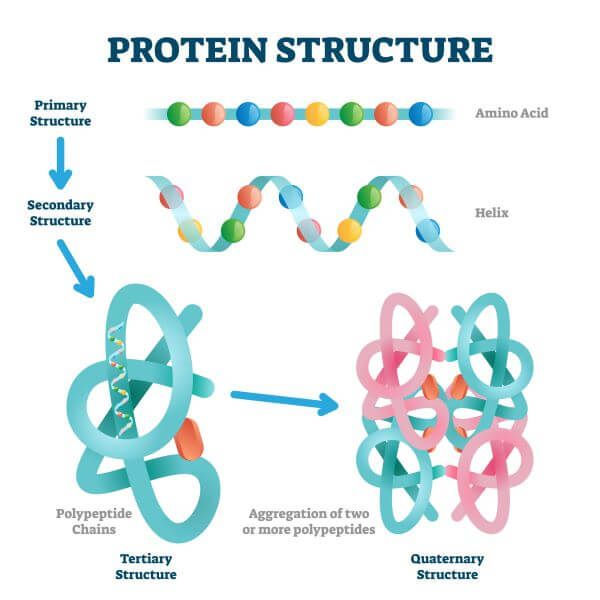
Proteins also have four levels of structure:
- Primary: the simple string of amino acids that forms a polypeptide chain, often millions of amino acids long;
- Secondary: complex loops, helices and or pleats are formed in the string of amino acids by hydrogen & sulfide bonds;
- Tertiary: the pleats, loops and helices fold over each other creating a three dimensional structure; and
- Quaternary: several of these 3-D polypeptide chains interlock.
The primary structure of proteins corresponds to the pshat of Torah: like amino acids, letter follows letter, word follows word, all in perfect order. This is the simplest meaning of Torah, the "quaint Bible stories" that most third graders know.
It is also interesting to note that there are 22 amino acids that are found in proteins; of these, only 20 are specified by the universal genetic code. (The others, selenocysteine and pyrrolysine use tRNAs that are able to base pair with stop codons in the mRNA during translation.)
There are also 22 letters in the Hebrew alphabet.
The secondary structure of proteins corresponds to the Remez of Torah: heikesh and gezaira shava (hermeneutical tools) are like the hydrogen and sulfide bonds that create loops and helices in the text;
The tertiary structure of proteins is the Drash: this includes the universe of exegesis, how we connect incidents in different parts of the Torah to each other, making the text come alive in 3-D, as it were; and
The quaternary structure of proteins corresponds to Sod: how the Five Books of Moses work seamlessly to create one integrated, organic whole.
Seven variant texts were incorporated into the standard Uthmanic Koran, and Moslem scholars freely admit that transcription errors have crept in over the centuries.
But there's only one Torah. We have intact Torah scrolls dating back to the 12th century, and fragments going back two millennia. And they're all identical. Stop and think about that.
On a stormy summer Saturday morning 3,335 years ago, at the foot of a nondescript hill in the middle of nowhere, millions of people were eyewitness to the Revelation of Sinai. But, incredibly, we don't have millions of versions of what happened there. This is all the more remarkable in light of the overused aphorism about Jews: 'From two Jews, you'll get three opinions." (have you ever been to a synagogue board meeting?) We have only the one. No variants, no alternative fragments, no extra or deleted verses. No Torah of Korach the Rebel. No Sadducee Torah. No Karaite Torah. No Sephardi Torah, no Ashkenazi Torah. Just the one Torah, the very text given by Gcd to Moses, and faithfully and painstakingly transmitted from generation to generation since.
Understanding the provenance and authority of Torah is central to understanding who we are as Jews.
From a cryptic story told in Tractate Chagigah 14b, we learn that Torah study is divided into four layers of increasing complexity:
- Pshat: the plain meaning of the verses;
- Remez: hints, i.e., esoteric meanings of the verses beyond the simple;
- Drash: homiletics; and
- Sod: the deepest secrets of the verses.
The acronym for these layers is "Pardes" meaning an orchard or garden, and is the source for the English word paradise.
This gemara has always made me think of...proteins.
When you stop sniggering I'll explain.
Proteins are the backbone of life. DNA are tinkertoys compared to the complexity of proteins. Beyond the structural value of proteins like muscle, hair and organs, millions of metabolic processes in the human body are mediated by enzymes (which are a specialized form of protein) custom engineered to their specific task. Without enzymes life is not possible.
Proteins also have four levels of structure:
- Primary: the simple string of amino acids that forms a polypeptide chain, often millions of amino acids long;
- Secondary: complex loops, helices and or pleats are formed in the string of amino acids by hydrogen & sulfide bonds;
- Tertiary: the pleats, loops and helices fold over each other creating a three dimensional structure; and
- Quaternary: several of these 3-D polypeptide chains interlock.
The primary structure of proteins corresponds to the pshat of Torah: like amino acids, letter follows letter, word follows word, all in perfect order. This is the simplest meaning of Torah, the "quaint Bible stories" that most third graders know.
It is also interesting to note that there are 22 amino acids that are found in proteins; of these, only 20 are specified by the universal genetic code. (The others, selenocysteine and pyrrolysine use tRNAs that are able to base pair with stop codons in the mRNA during translation.)
There are also 22 letters in the Hebrew alphabet.
The secondary structure of proteins corresponds to the Remez of Torah: heikesh and gezaira shava (hermeneutical tools) are like the hydrogen and sulfide bonds that create loops and helices in the text;
The tertiary structure of proteins is the Drash: this includes the universe of exegesis, how we connect incidents in different parts of the Torah to each other, making the text come alive in 3-D, as it were; and
The quaternary structure of proteins corresponds to Sod: how the Five Books of Moses work seamlessly to create one integrated, organic whole.
Instead of thinking of the Torah as a string of words that tell a story, try to picture the Torah in 3-D: not so much a beginning, middle and end, but more like words linking words, folding, twisting, reaching out from Genesis over to Numbers, arching over from Exodus to Deuteronomy, creating a dazzlingly complex 3-D structure of ideas.
And just like an enzyme, any minor alteration of the primary structure will affect the final 3-D structure and functionality of the whole. Every word and space MUST be in it's proper place. That is why it is critical to our faith that there be no transcription errors, omissions, extra letters or any other modification to the Holy Text. Any Torah with a scribal error or a missing/added letter is declared "Pasul," unfit for learning.
The metaphor can be extended. One idea of how enzymes work is called the lock-and-key model. The 3-D structure of the protein creates a highly specific receptor designed for a specific substrate. When the substrate 'locks' into the enzyme, it alters the 3-D structure of the enzyme-substrate complex. The metabolic process occurs, the substrate is released, and the enzyme returns to its original shape, ready to accept another substrate.

If Torah is the enzyme, then the substrate is the human mind. Like an enzyme, Torah is powerless by itself. But when we engage Torah, study it, grapple with its difficulties, reflect on it, laugh with it, we are both miraculously changed and amazing things happen in the universe.
The Torah is a singular document. It's not Shakespeare or Melville. The more we study it, the more it reveals it's depth, it's eloquence, it's complexity; the more it becomes apparent that no human - not even a Moses - could have been brilliant enough to forward-engineer a document that works on so many independent levels, and levels within levels.
So perhaps it should come as no surprise that direct analogues exist between the way we're built and the way the Torah is built; after all, each was designed for the other and both share a common Author.
Now that's an axiom I can hang my hat on.
Chag Sameach & Shabbat Shalom.
And just like an enzyme, any minor alteration of the primary structure will affect the final 3-D structure and functionality of the whole. Every word and space MUST be in it's proper place. That is why it is critical to our faith that there be no transcription errors, omissions, extra letters or any other modification to the Holy Text. Any Torah with a scribal error or a missing/added letter is declared "Pasul," unfit for learning.
The metaphor can be extended. One idea of how enzymes work is called the lock-and-key model. The 3-D structure of the protein creates a highly specific receptor designed for a specific substrate. When the substrate 'locks' into the enzyme, it alters the 3-D structure of the enzyme-substrate complex. The metabolic process occurs, the substrate is released, and the enzyme returns to its original shape, ready to accept another substrate.
If Torah is the enzyme, then the substrate is the human mind. Like an enzyme, Torah is powerless by itself. But when we engage Torah, study it, grapple with its difficulties, reflect on it, laugh with it, we are both miraculously changed and amazing things happen in the universe.
The Torah is a singular document. It's not Shakespeare or Melville. The more we study it, the more it reveals it's depth, it's eloquence, it's complexity; the more it becomes apparent that no human - not even a Moses - could have been brilliant enough to forward-engineer a document that works on so many independent levels, and levels within levels.
So perhaps it should come as no surprise that direct analogues exist between the way we're built and the way the Torah is built; after all, each was designed for the other and both share a common Author.
Now that's an axiom I can hang my hat on.
Chag Sameach & Shabbat Shalom.
Thursday, January 2, 2014
Bumper Sticker Theology - Reflections on Parashat Bo 5774
A bumper sticker caught my eye the other day. It joyously proclaimed the bumper stickee to be at "One With the Earth."
Things that make you go hmm...What does it really mean to be at "One With The Earth"? If you're literally One With The Earth, you've achieved ambient temperature, taken the dirt nap, are pushing up daisies, etc. (But they drive a car, so they can't be dead. Are zombies One with the Earth?) Hmmm...Anyway, it probably means living in synchronicity with the Earth, maybe rising at dawn and sleeping at dark...nope, that would be One with the Sun. How do you apply for "Earth-Onedness"? Is there a test? Written or oral? Is it graded on a curve? (Hopefully it's a self-test.) The questions just keep coming.
And that, in turn, got me thinking about this week's parasha (naturally).
In Parashat Bo we read of the final three plagues against Pharaoh and Egypt, of the first mitzvot commanded by Gcd to the Jews, and of the final preparations before emancipation.
There is a very rich wellspring of commentary on the ten plagues, making sense of the whys and the wherefores, insights on their specific order, how the punishments befitted the crimes, and how each plague exposed a specific Egyptian deity to ridicule and abuse, and more.
But apparently this brilliant body of commentary is not enough, for I am going to intrepidly suggest an understanding of the ten plagues based upon the above-mentioned bumper sticker.
These are the ten plagues:
1. Starting with the Nile, all the water in Egypt turns to blood;
2. Frogs come up from the Nile, infesting all of Egypt;
3. Lice;
4. Rampaging wild animals;
5. Animal fever, which kills off the horses, mules, camels, sheep and cattle;
6. Boils;
7. Fiery hail;
8. Mega locust attack;
9. Darkness; and
10. The death of every first-born Egyptian.
The first two plagues are grounded in water - they both start in the Nile River.
The next three are grounded in earth. Moses and Aaron are commanded to hit the 'dust of the earth' to begin the plague of lice. (Exodus 8:12) Plagues Four and Five focus on land animals.
The next two are grounded in fire. Moses and Aaron are commanded to take furnace ashes and throw them into the air to begin the plague of boils. (Exodus 9:8) And the hail was famously fire wrapped in ice.
The next two plagues are grounded in air. The locust swarms attacked from the air and were so dense that they blotted out the sun. And darkness speaks for itself.
Leaving the most horrific plague - death - for last.
Water. Earth. Fire. Air. The four ancient elements.
Pharaoh steadfastly rejects the Divine Command to release the Jewish People from bondage. Like every anti-semite before or since, his beef is not with the Jewish People per se, but with what - and whom - we represent. Pharaoh's fight was with Gcd.
And in response, the A-lmighty says (as it were): "If you stand in opposition to Me, then you will find that all of nature, my entire created universe, will stand in opposition to you: water, earth, fire, air. And if you persist in your rebellion, you make yourself the enemy of Life itself (the Tenth Plague)."
We are taught that every aspect of the universe, animate and inanimate, serves Gcd in its own unique way. Dogs bark, cats meow, wolves bay at the moon, and dolphins click. "Fire and hail, snow and mist, stormy wind all fulfill His word." (Psalm 148) Even the celestial orbs praise Gcd, oscillating in their orbits (and the oscillations make them - literally - hum. Re-read Psalm 19:2).
Of all Gcd's creations, only humans have the power to disobey Gcd. But as Pharaoh learned to his detriment: when we choose that path, the universe becomes our enemy. We're like the one rogue car, driving the wrong side of the busy superhighway of life.
To be as one with a universe that serves Gcd, we too have to serve Gcd. We accomplish this, not by reducing our carbon footprint, driving hybrids or recycling, but by subordinating our will to Gcd's Will; living with the recognition that whatever I want to do at any given moment in time is less important that what Gcd wants me to do with that moment.
What is Gcd's Will? Open the Torah, study the laws. Like the old spaghetti sauce ad, it's all in there. That's how we achieve genuine synchronicity, balance and inner peace.
So on the whole, I'd rather be one with the Creator of the Earth than with the earth itself.
Now, if we could only figure out how to recycle poopik lint or the green effluent of little children's noses, we'd be set...
Shabbat Shalom.
Things that make you go hmm...What does it really mean to be at "One With The Earth"? If you're literally One With The Earth, you've achieved ambient temperature, taken the dirt nap, are pushing up daisies, etc. (But they drive a car, so they can't be dead. Are zombies One with the Earth?) Hmmm...Anyway, it probably means living in synchronicity with the Earth, maybe rising at dawn and sleeping at dark...nope, that would be One with the Sun. How do you apply for "Earth-Onedness"? Is there a test? Written or oral? Is it graded on a curve? (Hopefully it's a self-test.) The questions just keep coming.
And that, in turn, got me thinking about this week's parasha (naturally).
In Parashat Bo we read of the final three plagues against Pharaoh and Egypt, of the first mitzvot commanded by Gcd to the Jews, and of the final preparations before emancipation.
There is a very rich wellspring of commentary on the ten plagues, making sense of the whys and the wherefores, insights on their specific order, how the punishments befitted the crimes, and how each plague exposed a specific Egyptian deity to ridicule and abuse, and more.
But apparently this brilliant body of commentary is not enough, for I am going to intrepidly suggest an understanding of the ten plagues based upon the above-mentioned bumper sticker.
These are the ten plagues:
1. Starting with the Nile, all the water in Egypt turns to blood;
2. Frogs come up from the Nile, infesting all of Egypt;
3. Lice;
4. Rampaging wild animals;
5. Animal fever, which kills off the horses, mules, camels, sheep and cattle;
6. Boils;
7. Fiery hail;
8. Mega locust attack;
9. Darkness; and
10. The death of every first-born Egyptian.
The first two plagues are grounded in water - they both start in the Nile River.
The next three are grounded in earth. Moses and Aaron are commanded to hit the 'dust of the earth' to begin the plague of lice. (Exodus 8:12) Plagues Four and Five focus on land animals.
The next two are grounded in fire. Moses and Aaron are commanded to take furnace ashes and throw them into the air to begin the plague of boils. (Exodus 9:8) And the hail was famously fire wrapped in ice.
The next two plagues are grounded in air. The locust swarms attacked from the air and were so dense that they blotted out the sun. And darkness speaks for itself.
Leaving the most horrific plague - death - for last.
Water. Earth. Fire. Air. The four ancient elements.
Pharaoh steadfastly rejects the Divine Command to release the Jewish People from bondage. Like every anti-semite before or since, his beef is not with the Jewish People per se, but with what - and whom - we represent. Pharaoh's fight was with Gcd.
And in response, the A-lmighty says (as it were): "If you stand in opposition to Me, then you will find that all of nature, my entire created universe, will stand in opposition to you: water, earth, fire, air. And if you persist in your rebellion, you make yourself the enemy of Life itself (the Tenth Plague)."
We are taught that every aspect of the universe, animate and inanimate, serves Gcd in its own unique way. Dogs bark, cats meow, wolves bay at the moon, and dolphins click. "Fire and hail, snow and mist, stormy wind all fulfill His word." (Psalm 148) Even the celestial orbs praise Gcd, oscillating in their orbits (and the oscillations make them - literally - hum. Re-read Psalm 19:2).
Of all Gcd's creations, only humans have the power to disobey Gcd. But as Pharaoh learned to his detriment: when we choose that path, the universe becomes our enemy. We're like the one rogue car, driving the wrong side of the busy superhighway of life.
To be as one with a universe that serves Gcd, we too have to serve Gcd. We accomplish this, not by reducing our carbon footprint, driving hybrids or recycling, but by subordinating our will to Gcd's Will; living with the recognition that whatever I want to do at any given moment in time is less important that what Gcd wants me to do with that moment.
What is Gcd's Will? Open the Torah, study the laws. Like the old spaghetti sauce ad, it's all in there. That's how we achieve genuine synchronicity, balance and inner peace.
So on the whole, I'd rather be one with the Creator of the Earth than with the earth itself.
Now, if we could only figure out how to recycle poopik lint or the green effluent of little children's noses, we'd be set...
Shabbat Shalom.
Thursday, December 12, 2013
Teach Your Children Well - Reflections on Parashat VaYechi 5774
"It
is easier to build strong children than to repair broken men."
- Fredrick Douglass
How do we go about raising Jewish children in a decadent, permissive, non-Jewish culture?
This by no means an academic question. Based on the recent Pew Study on American Jewish life, we are making a hash of it: two-thirds of Jews born after 1980 see their Jewishness purely as an ethnic identity, with no moral/religious component at all.
As usual, the Torah, the Owner's Manual of Life, the official publication of the Manufacturer of Life, can help us out here. Specifically, let's look at the way that Joseph raised his kids in Egypt.
Joseph's sons, Menashe & Ephraim, were remarkable young men. R' S.R.
Hirsch suggests that, due to both good home-training and
temperament, they steered clear of the corrupting allures and
indulgences available to them as Egyptian courtesans. This personal moral accomplishment is all the more remarkable in light
of a noteworthy Onkelos which says that as Viceroy, Joseph had to teach Torah to his sons in secret. (Genesis 49:24) So in spite of having no contact with
the Israelite clan in Canaan, and in spite of the hardships of living as crypto-Jews,
they somehow figured out how to preserve the highest levels of Jewish ethical conduct in a very depraved Egyptian culture.
For Rabbi Hirsch, Menashe & Ephraim are the exemplars of Torah Im Derech
Eretz (the Ideal Synthesis of Torah and Worldliness).
Most parents would agree that setting healthy boundaries is a critical part of child rearing. This is doubly true for Jewish parents who have to establish special food boundaries (no McDonalds) and special time boundaries (no Saturday morning cartoons) in a meaningful context to their kids. How did Joseph (and Mrs. Joseph) do it?
Before we answer that question, I'd like to briefly outline two of the dominant teaching modalities that I have observed in Jewish education; as we shall see, each suggests
themselves from Joseph's formative experiences in Egypt.
The Issur
of Chov
One way to teach Jewish boundaries is to simply impose them on the child; I call this the "Issur of Chov". The Issur
of Chov is an issur of absolutism. It is imposed by a force extrinsic to self,
and brooks no challenge to its authority. The Issur of Chov focuses primarily
on compliance and conformity. Precisely because obligation is imposed from without,
it emphasizes the externalities of keeping the mitzvot: very narrow definitions of appropriate dress, proper neighborhoods in which to live, proper friendships and associations, things that are very public and very measurable. It focuses on phenotype,
(defined in this context as) the outward manifestation of religiosity, the
religious act. Because Chov cannot reach the life of the mind, it de-emphasizes
it. This is the mindset that advocates "Mitzvah Ainah Tzrichah Kavanah," that intentionality is not necessary to do a mitzvah.(Tractate Brachot 13a)
Indeed,
the Issur of Chov vigorously discourages independent thought or the development
of critical thinking skills as dangerous to Pure Faith. Children raised in the
context of Chov are reprimanded for rebelliousness and heretical thinking if they
ask questions on the fundamentals of faith. The Issur of Chov has little use for
the native, wondrous spirit of intellectual inquiry which resides in the heart
of every child. That spirit is systematically stifled and suffocated, and a
blind obedience to the Halacha and authority is grafted into its place.
Obedience, not insight, is the overarching educational objective. Kabalat Ol
Malchut Shamayim is in the model of Har K'Gigit, meaning that the Jewish People were in a certain sense coerced to accept the Sinaitic Covenant (Tractate Shabbat
88a).
Broadly
speaking, Chov demands the abnegation of self and the subordination of free will, and imposes a level of conformity in personal behavior that is
necessarily intrusive and dehumanizing. Chov develops for itself a society
which is definitionally insular, condescending, xenophobic and exclusionary. This evolves
because a religiosity that is fundamentally extrinsic to self demands
validation from without. Peer approval is more important than the personal introspection and self-improvement, the cheshbon
hanefesh. Thus Chov requires ever expanding levels of restrictions to both
insulate it's adherents and protect the "purity" of it's Torah from dangerous foreign ideas. In defiance of the halachah, new restrictions are piled on old restrictions, and machmirut (legal strictness) is the argot of Chov. It's worldview is self-referential, having no need to reality-test it's axioms. It is
primarily the Torah of Yirah, Fear of Gcd.
The Issur
of Reshut
The better, harder way I term the Issur of Reshut, i.e., of opting in to the Jewish belief system. The Issur
of Reshut is expansive and liberating, not constraining. It begins from the
place of unencumbered free will, recognizing that there is no authentic
religious impulse in its absence. It
seeks to cultivate a love of Torah and Mitzvot that is intrinsic to self.
Accordingly, intellectual inquiry is protected and cultivated; indeed, children
are encouraged to ask their most deeply-held questions, most especially
questions on the fundamentals of faith, the Yesodei HaDat. The Issur of Reshut focuses on genotype, on
the development of inner character [middot tovot] and critical thinking
skills. Outward manifestations of religiosity are less emphasized; when
"organic" middot are in place, we find the chizoniut/externality takes care
of itself. This is the mindset that advocates "Mitzvah Tzrichah Kavanah," that intentionality is necessary to do a mitzvah.
The Issur
of Reshut provides a framework to develop in children the intellectual
faculties to make wise and responsible choices, and provides contextual tools to help make
sense of the confusing world in which we live. Reshut allows for a broader
understanding of issur baTorah/Torah-based boundaries: namely, that Hashem, the Author of Life, has
given us the Torah, the "handbook" for the conduct of our lives. Our daily prayers teach that every choice, no matter how seemingly insignificant,
has profound moral consequences. The
result of good decision-making is the life they experience in their home: a
life of blessing/bracha, of inner peace/shalvat nefesh, of love of Torah/ahavat Torah, and of domestic tranquility/shalom
bayit. The consequences of non-compliance are exactly the opposite. Kabalat
Ol Malchut Shamayim is on the model of "Kimu v'Kiblu," meaning that the Jewish People opted-in to the Sinaitic Covenant. (Esther 9:27)
The Issur
of Reshut remembers that the Talmudic Sages were lenient whenever possible, and strict only when necessary. So rather than
insulate children from the greater world which we all inhabit, the Issur of Reshut
encourages young Jewish men and women to venture into the world and reality-test their beliefs; to observe for
themselves the poverty of spirit in to be found in a life without the blessings of mitzvah observance/Shmirat
HaMitzvot.
The Issur
of Reshut emphasizes that ultimately, free will is the domain
reserved exclusively for the individual, who must also bear the full consequences of his
choices. It is primarily the Torah of Ahavah, of love of Gcd.
Yosef
B'Veit HaSohar
We see
hints to these two divergent approaches in Joseph's experiences in
Egypt.
The physical imprisonment that Joseph experienced in the in prison is analogous to the spiritual imprisonment created by the Issur of Chov. (Genesis 39:20 ff) As a prisoner, Joseph is deprived of personal
autonomy and stripped of his essential humanity, i.e., the ability to exercise
his free will. He must conform to norms of behavior extrinsic to himself.
Reward and punishment are meted out on the basis of compliance, conformity and
obedience. This is the Joseph that bitterly screams the plaintive cry of a victim, "I've been done wrong! I'm innocent I tell ya!" (Genesis 40:15) He is the quintessential "Man of Fate" as described by R' Y. B. Soloveitchik: a pawn
of grand cosmic forces that he cannot possibly hope to fathom; a mere object in a
cruel and uncaring world over which he has no control.
Yosef
B'Veit Potiphar
Joseph's earlier experiences in Potiphar's household correspond to the Issur of
Reshut. As major domo of Potiphar's
household, he possesses exceptionally far-reaching powers in the conduct of his
world. He comes and goes as he pleases; he is rewarded for the application of
his intrinsic strengths to the management of Potiphar's affairs: integrity,
efficiency and innovative thinking. He has a framework, his Torah worldview, to understand the flawed and debased world in which he lives, and
how his value system distinguishes him from others. This is the Joseph that has
the moral stamina to resist the irresistible seductions of Potiphar's wife. In Potiphar's house he evinces R' Soloveitchik's "Man of Destiny," a person
able to (at least in some measure) be the subject of his world, to mold it and
leave his mark upon it.
Joseph suddenly finds himself out of jail and thrust into the position of Viceroy, the
second most powerful man in the world. Every choice he can imagine is now laid
before him. He also intuits that no matter how successful he is in his new
role, he will forever be the Ivri, the Other, in the eyes of the cognoscenti of
Pharaoh's court. He cannot assimilate and escape his Jewishness; he knows that neither he nor
his children nor his children's children will ever be "real" Egyptians. Joseph makes peace with
that reality. He must therefore find a modus vivendi to effectively synchronize
the two worlds he cohabits. Moreover, as his sons mature, he must teach them
this critical survival skill. Will he be the rigid didact, insulating them
against their environment, or will he teach them his more nuanced shita/approach,
contextualizing Egyptian society and defining their role in it, as he did in Potiphar's house?
Joseph chooses the path of
Reshut. Rashi says that Yosef's
counselor in international affairs and multilingual interpreter was none other
than Menashe his elder son; thus demonstrating that they were fully engaged in
the greater world they inhabited. (Genesis 42:24)
Contrasting
Educational Approaches
In our
day, each approach has adherents across the spectrum of the Torah world. Further, each is possessed of certain well-defined risks and
benefits, advantages and disadvantages.
Issur of
Chov has, as it's primary advantage, easily defined metrics for success. Based
as it is on external behaviors, parents and educators in the Chov-based
environment can easily measure compliance or non-compliance.
But the
disadvantages are profound: the sub-text Chov conveys to the child is
threefold: (1) Torah Chalasha Hee - Torah is very fragile and can only
survive in the rarified atmosphere of the enclave; accordingly, it has no place
in the Greater World. (2) You yourself are fragile; your teachers and
parents don't invest enough trust in you to make life choices responsibly. (3)
Your faith is fragile; basic questions of faith are forbidden because
ultimately there are no answers.
The Jewish
world is reeling over the epidemic of Yeshivah-educated teenagers openly
rebelling in Shmirat HaMitzvot. When Judaism is a spiritual prison/hesger nefesh
for our children; when issur is chal al issur; when Halachah is
viewed as an obstacle to self-expression and self-fulfillment; can we expect
otherwise? The surest way to get a teenager to do something is to forbid it.
As
mentioned earlier, the Chov-based educational model tends, over time, to
self-organize into exclusionary enclaves. Homogeneous communities present the
chimera of unity; a feeling of inoculation and imperviousness against the
shifting morays and other vagaries and excesses of Modernity; and a sense of
continuity across the span of generations.
Many people willingly opt-in to Chov-based societies, deriving much
succor and security in the certitudes of Chov. For such people, the surrender
of some of their personal autonomy to the commune is a reasonable price to
pay for inclusion. Conformity thus replaces scholarship as the sine qua non of
Jewish life.
We now
read of Rashei Yeshivot (heads of school) who for years, decades, ignored pedophilia and other abominations in their yeshivot by individuals who lived in the right neighborhoods and wore the right clothes; of rabbanim who provided "counseling" to teenage
girls and destroyed the kedushat habayit of untold future Jewish
homes; of their active and purposeful obstruction of justice; of an epidemic of
domestic violence, marital rape, alcoholism and financial wrongdoings
previously unheard-of among Jews; and many other corruptions. We
watch in revulsion as Va'adei Tzniut/Modesty Committees enforce the Issurim of Chov,
punishing even the slightest deviation from the social "norm" with
verbal abuse and broken bones. The Issur
of Chov creates a societal exoskeleton of pseudo-Halachah which produces these
ineluctable results.
What of the other approach? Guiding our children on the path of the
Issur of Reshut also has inherent risks and disadvantages. One disadvantage
(such as it is) of the Issur of Reshut is that it requires a lot more work to
raise children. We must be prepared to answer hard questions from our
kids. We must address the "whys?" not only the "hows?" We must do a lot of listening. The biblical obligation to educate our children in Torah cannot - must not - be completely delegated to others; we must be
continuously engaged in the ethical development of our children. That which we
demand of them, they must see practiced in our lives: intellectual and
moral integrity, consistency, balance, joie de vivre, passion for Tefillah/prayer,
ahavat Torah, compassion to all of Gcd's creatures, a burning desire to
do the Ratzon/Will of Hashem, and shalvat nefesh/inner peace. Like Joseph,
we must make peace with being "Ivrim," living as strangers in a strange land; after all, we are History's consummate
non-conformists.
The
sub-text Reshut conveys is also threefold: (1) Torah Chazaka Hee - Torah
was intended to be lived in the world - "Lo Bashamayim Hee"
(Deuteronomy 30:11 ff.); it is strong,
indestructible - Torah ainah mikabelet tumah; and as such it is our
guidebook for successful living in the Greater World. (2) You are strong;
your teachers and parents trust in you to make life choices responsibly. (3)
Your faith is strong; answers to every question of faith can be found in
the Torah. No subject is ever off-limits.
The major
risk of teaching the Issur of Reshut is a terrifying one: that in the end,
there are no guarantees that our children will choose our path, the path of their forbears, the path of Abraham, Isaac and Jacob. Kids must be allowed to make mistakes. Our children may (and probably will) make the wrong
choices at times; a few will make consistently bad choices and will have to
deal with the painful consequences that attend to them. But ultimately, we
cannot deny our children their free will; it is granted by
Hashem, not by parents, Rabbanim, or society. Our job as parents is to guide
them towards utilizing their free will, the power to literally
create and destroy worlds, beneficently, as moral agents in the service of
their Maker.
By
teaching a Torah that preserves their intellectual integrity; by teaching a halachah that isn't an impediment to personal growth and development but rather
facilitates it; by cultivating a mindset of R' Soloveitchik's "Man of
Destiny," we walk the path of Yosef HaTzaddik. Like
Menashe and Efraim, the Issur of Reshut cultivates the strong moral agency we
desire in our kids and the future leaders of the Jewish People.
Shabbat Shalom.
Subscribe to:
Posts (Atom)